The Quiet Revolution: How AI and Machine Learning Are Reshaping FinTech and Healthcare, and Why You Need to Be Part of It
Companies are sitting on billions in AI investment and cannot ship it. Not because the models are bad, but because they lack the engineers. Here is what AI and ML are actually doing in FinTech and Healthcare right now, and why this is the moment to build these skills.

14 min read
Contents
By Rev. Dr. Emmanuel Naweji | Founder, T2S: Transformed 2 Succeed | AI/ML/Robotics Researcher and Educator
There is a revolution happening right now. It is not loud. It does not make the front page every morning. But within hospitals, banks, insurance companies, and other financial institutions that shape daily life for billions of people, artificial intelligence and machine learning are quietly rewriting the rules for how decisions are made, how diseases are detected, how fraud is stopped, and how money moves.
I have spent years at the center of that revolution, not as an observer, but as a practitioner. My doctoral research focused on applying AI, machine learning, and robotics to two of the most demanding environments imaginable: financial services and healthcare. These are industries where the stakes are not hypothetical.
A wrong prediction in a credit model can destroy someone's financial future. A missed diagnosis in a clinical AI system can cost a life. A security breach on a payment platform can wipe out a company overnight.
I have worked with some of the world's leading tech companies. I have built systems that operate in regulated environments where failure is not an option. And for years, alongside my work as a researcher, engineer, and educator, I have also served as a pastor and mentor, because I believe that transforming people's lives through knowledge is one of the most important things any of us can do.
This article is the distillation of everything I have learned. And at the end, I want to make you a very specific offer.
The Numbers That Should Stop You in Your Tracks
Before we get into the how, let us establish the why.
The AI in healthcare market is on track to grow from $25.74 billion in 2024 to over $419 billion by 2033. That is not a rounding error. That is a 36% compound annual growth rate, sustained for nearly a decade. Meanwhile, JP Morgan Chase's internal GenAI tools were already being used by more than half of its 200,000 employees by Q1 2025, generating nearly $1.5 billion in identified cost savings in a single quarter.
These are not pilot programs anymore. This is production. This is at scale. And the demand for engineers who understand how to build, deploy, and maintain these systems is far outpacing the supply.
The companies are ready. The investment is there. What is missing are the engineers.
What AI and Machine Learning Are Actually Doing in FinTech
Let me be specific, because the word "AI" gets thrown around so loosely it has almost stopped meaning anything. Here is what machine learning looks like in the financial industry right now, in production, at companies you have heard of.
Fraud Detection That Learns Faster Than Fraudsters
Traditional fraud detection was built on rules. If a transaction looks like X, flag it. The problem is clear: fraudsters read the rules and adapt. Static rule engines generate enormous numbers of false positives, which cost money and erode customer trust, while still missing sophisticated, adaptive attacks.
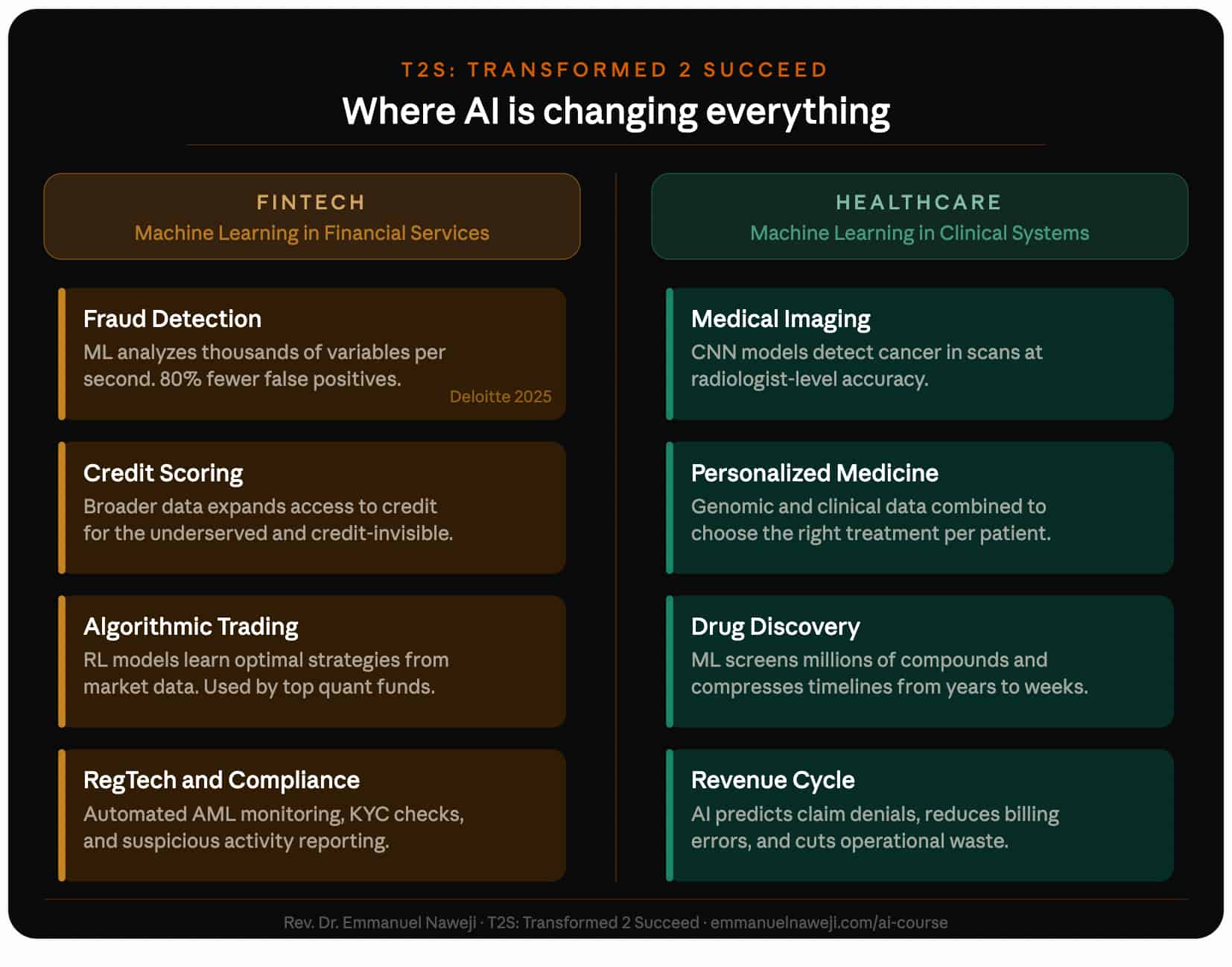
Machine learning changes the game entirely. Modern fraud detection models analyze thousands of variables simultaneously: behavioral patterns, device fingerprints, geolocation data, transaction velocity, spending history, and they continuously retrain on new data.
Deloitte has projected that AI-driven fraud detection systems will reduce false positives by up to 80%. The system learns faster than any human team could ever update a rulebook. And it catches new attack vectors that legacy systems never could: deepfake-driven identity fraud, synthetic identity schemes, and AI-powered social engineering.
This is one of the areas I studied deeply during my doctoral research. The challenge is not just about building an accurate model. It is about building a model that is explainable, auditable, and fair, especially when that model makes decisions that affect someone's access to financial services.
Those requirements do not make engineering easier. They make it richer, and they are exactly what separates a competent ML engineer from an exceptional one.
Credit Scoring That Sees the Whole Person
Traditional credit scoring looks at a narrow slice of someone's financial life: credit history, debt-to-income ratio, and payment history on existing accounts.
For the hundreds of millions of people globally who are credit-invisible under that system, recent immigrants, young adults, and people who have transacted primarily in cash, the traditional model simply says "unknown" and closes the door.
Machine learning opens that door. By analyzing a broader range of data points, rent payment history, utility bills, mobile phone payment patterns, employment stability signals, ML models can assess creditworthiness far more accurately, especially for people who have been systematically excluded from the traditional financial system.
This is not just a technical achievement. It is a matter of economic justice. And it is exactly the kind of problem that makes working in AI for FinTech meaningful work.
Algorithmic Trading That Outthinks the Market
Quantitative trading funds have been using algorithms for decades. But the generation of ML-driven trading systems that exists today is categorically different from what came before. Modern systems process high-frequency market data, alternative data sources, satellite imagery of retail parking lots, shipping container traffic, social media sentiment, and unstructured text, and extract predictive signals that no human analyst could identify, let alone act on in time.
Renaissance Technologies and BlackRock have built some of their most successful strategies on exactly this foundation. Reinforcement learning algorithms optimize trading policies through trial and interaction with actual market data, continuously refining themselves as conditions change.
The human role has not disappeared; skilled analysts still interpret what the models identify and make final judgment calls, but the analytical power available to those humans has multiplied enormously.
RegTech: Making Compliance Intelligent
Regulatory compliance in financial services is an enormous operational burden. Anti-money laundering monitoring, Know Your Customer verification, suspicious activity reporting, and Basel capital requirement calculations all generate massive volumes of data and require continuous vigilance. AI agents are being deployed to handle the monitoring, pattern detection, and preliminary reporting that previously required armies of compliance analysts. The accuracy is higher; the speed is faster, and the audit trail is cleaner.
What AI and Machine Learning Are Doing in Healthcare
If the stakes in FinTech are high, the stakes in healthcare are higher. Here, the subject is not money. It is lives.
Medical Imaging and Diagnostics
This is the most mature AI application in clinical medicine, and the results are genuinely remarkable. Convolutional neural networks trained on millions of medical images have achieved radiologist-level accuracy in detecting lung cancer in CT scans, identifying diabetic retinopathy in retinal photographs, and flagging potential strokes in MRI images.
In some narrow diagnostic tasks, well-designed AI systems outperform average radiologists.
This does not mean radiologists are obsolete. It means that every radiologist who works alongside these systems becomes more accurate and can cover more patients.
In a world with a severe shortage of diagnostic specialists, particularly in low-resource settings, AI-assisted diagnosis is not a luxury. It is a necessity.
My research engaged with exactly these kinds of systems, the engineering challenges of deploying diagnostic AI in regulated clinical environments, where every output needs to be explainable to a clinician, auditable by a regulator, and trustworthy enough to influence a medical decision.
Personalized Medicine
The era of one-size-fits-all medicine is ending. ML models that can process genomic data, electronic health records, lifestyle data, and clinical history are enabling a new model of care: treatment tailored to the individual.
The most powerful application is in oncology. Two patients with the same cancer diagnosis can have tumors that are genetically distinct and respond to completely different treatment protocols.
ML models trained on large genomic and clinical datasets can identify which protocol is most likely to work for a specific patient's tumor profile, turning a guessing game into a data-driven decision.
Machine learning algorithms are also being deployed to identify illness risks before symptoms appear, forecast which patients are likely to deteriorate, and recommend drug combinations for complex conditions, including rare diseases, mental health disorders, and late-stage cancers.
Clinical Operations and the Revenue Cycle
Healthcare administration is extraordinarily complex and extraordinarily inefficient. Hospital billing alone consumes enormous resources and results in billions of dollars in losses annually due to coding errors, claim denials, and fraud. AI models are now predicting claim denials before submission, optimizing billing code selection, and flagging anomalies that indicate potential fraud, saving healthcare systems money that can be reinvested in care.
On the clinical side, AI-powered virtual assistants are automating scheduling, documentation, and administrative workflows, thereby directly reducing clinician burnout, one of healthcare's most pressing crises.
When a doctor spends less time on documentation and more time with patients, the system works better for everyone.
Drug Discovery
The traditional drug discovery process takes a decade and costs billions of dollars, with a failure rate that would be unacceptable in any other industry.
Machine learning is compressing that timeline. Models screen millions of molecular compounds in days rather than years, predict how proteins fold and interact, optimize clinical trial design to identify the right patient populations faster, and flag safety signals earlier in the development process.
The impact of AlphaFold, DeepMind's protein structure prediction model, on biological research has been described as a scientific revolution.
The downstream engineering work of deploying and scaling tools like that in real clinical and pharmaceutical environments is exactly what AI/ML systems engineers do.
Where FinTech and Healthcare Converge
The most interesting frontier right now is the intersection of both industries: healthcare and finance.
Health insurance underwriting is being transformed by ML models that can assess individual health risk with far greater precision than actuarial tables. Value-based care payment models, where providers are reimbursed based on patient outcomes rather than services rendered, require continuous ML-driven monitoring of clinical data to calculate payments accurately.
Revenue cycle management at large health systems is being reshaped by generative AI that can automatically orchestrate complex billing and compliance workflows.
This convergence is creating categories of problems and roles that did not exist a decade ago. Engineers who understand both the clinical data infrastructure and the financial systems implications are extraordinarily rare and extraordinarily valuable.
The Regulated Environment Problem Nobody Talks About
Here is what most AI and ML courses get wrong. They teach you how to build models. They do not teach you how to deploy them in environments where those models will be scrutinized by regulators, challenged in court, and held to standards that general software does not face.
In healthcare, HIPAA governs how patient data is collected, stored, and used. FDA clearance is required before an AI system can influence clinical decisions. Every model output must be explainable, not just accurate. "The neural network said so" is not a legally defensible answer when a patient challenges a diagnostic recommendation.
In financial services, Basel III capital requirements shape how credit models are validated. Anti-money laundering regulations require audit trails that can reconstruct every decision a model made. SOC 2 and FedRAMP govern the infrastructure hosting these systems.
The engineers who understand these constraints and can build AI systems that are not just technically excellent but also compliant, explainable, and auditable are the most valuable in both industries. My doctoral research lived at exactly this intersection, and my years of experience with top tech companies showed me how rarely this combination of skills appears in the engineering talent pool.
Why I Built This Course
I have spent years as a researcher, an engineer, a mentor, and a pastor. Those roles might seem unrelated, but they share a common thread: the belief that knowledge, properly transmitted, changes the direction of people's lives.
I have seen talented people pass over for roles they could do because they lacked specific skills in AI, ML, systems engineering, and regulated environments. I have watched companies struggle to find engineers who could bridge the gap between data science and production infrastructure.
And I have watched both industries, healthcare and FinTech, grow faster than the talent pipeline could keep up with.
That is why I built the AI/ML Systems Engineering course at T2S: Transformed 2 Succeed.
This is not a survey course. It is not a collection of theory lectures. Every module is built around real skills that real employers are hiring for right now, with hands-on projects that build actual systems.
What you will build:
You will build AI and ML systems for FinTech and healthcare. Real pipelines. Real models. Real infrastructure. Not toy datasets on a local machine, but production-grade systems that you can demonstrate to any hiring manager or technical interviewer.
What you will learn:
- Python from the ground up, including the exact patterns that appear in technical interviews with top companies
- Docker, Kubernetes, and cloud platforms, the infrastructure that makes ML systems run at scale
- MLOps: CI/CD pipelines for models, continuous monitoring, model versioning, automated retraining
- AI Security Posture Management and how to protect ML systems against the specific threats they face
- How to operate AI systems in regulated environments: HIPAA, FedRAMP, SOC2, and the governance frameworks that go with them
- How to make models explainable and auditable, a skill that is becoming legally required in both industries
Who this course is for:
This course is for engineers who want to work at the intersection of AI, cloud, DevOps, SRE, and regulated industries. It is for people who have been trying to break into this field and need a pathway. It is for experienced engineers who want to move into AI/ML systems work.
And it is for anyone who wants to build things that matter: systems that help detect cancer earlier, prevent financial fraud, extend credit to people who deserve it, and make healthcare more efficient and more equitable.
The companies hiring for these roles are not waiting. The salaries are not waiting. The window is open right now, and it will not stay open forever.
The Case for Acting Today
AI adoption in healthcare was nearly flat through most of 2024. Then it accelerated by 481% at the turn of 2025. That is not a gradual climb. That is a cliff's edge. The organizations that had engineers ready to deploy AI systems at scale benefited immediately.
Those who did not are still scrambling to find the people they need.
In FinTech, the transformation is already mature. The question is no longer whether ML will be used for fraud detection, credit scoring, and algorithmic trading.
It is about whether your organization has engineers who can maintain, improve, and govern those systems as they scale and face increasing regulatory scrutiny.
The skills gap between what these industries need and what the current talent pool can provide is real, measurable, and growing. Every engineer who closes that gap for themselves becomes immediately demonstrably valuable.
This course closes that gap.
A Note From the Mentor
I want to say something that goes beyond the technical.
I have seen what happens when people get access to the right knowledge at the right time. It does not just change their income. It changes how they see themselves. It changes what they believe is possible. It changes the opportunities they can create for their families and communities.
That is what T2S: Transformed 2 Succeed is about. Not just teaching skills. Transforming trajectories.
The technical knowledge in this course is real. The career outcomes are real. And the community you will be part of, engineers who are doing serious work in some of the most important industries in the world, is real.
I have mentored students through career pivots, technical interviews, first engineering roles, and promotions. I know what it takes to get from where you are to where you want to be. I built this course to be the most direct path I can create.
Enroll Today
AI/ML Systems Engineering Course, www.emmanuelnaweji.com/ai-course
You will learn by building. You will graduate with a portfolio of real AI/ML systems for FinTech and healthcare. You will have the technical skills, knowledge of the regulated environment, and practical experience to compete for roles that most engineers cannot reach.
The companies are ready. The investment is there. The only question is whether you will be ready when the opportunity arrives.
Start your transformation at www.emmanuelnaweji.com/ai-course
Rev. Dr. Emmanuel Naweji is a doctoral researcher in AI/ML and Robotics applied to regulated environments, holds a Doctorate in Ministry with research in counseling, neuroscience, and biblical theology for personal healing, and brings years of experience working with top tech leading companies. He is the Founder and Mentor of T2S: Transformed 2 Succeed, and a pastor who believes that knowledge, purpose, and wholeness are the foundation of lasting transformation.
Connect: www.emmanuelnaweji.com/ai-course