You Don't Need a CS Degree to Build AI Systems. You Need THIS!
Let me tell you what I keep seeing.
I meet people who have been in IT for years, sysadmins, cloud engineers, DevOps professionals, healthcare IT specialists, who are watching the ground shift under their feet. They see AI happening everywhere.
They read the headlines. They watch colleagues get passed over for roles because someone else had "AI experience." And they feel stuck.
Then I meet people who are just starting out. They want to enter the technology field through the door that leads somewhere meaningful. They want to build things that matter.
They want a career in an industry that is growing faster than almost anything else right now.
Both groups believe the same lie: that AI is only for people who went to MIT. That you need a computer science degree. The door is already closed.
I am here to tell you that it is not true. And I am going to prove it.
The Market Is Real, and The Need Is Urgent
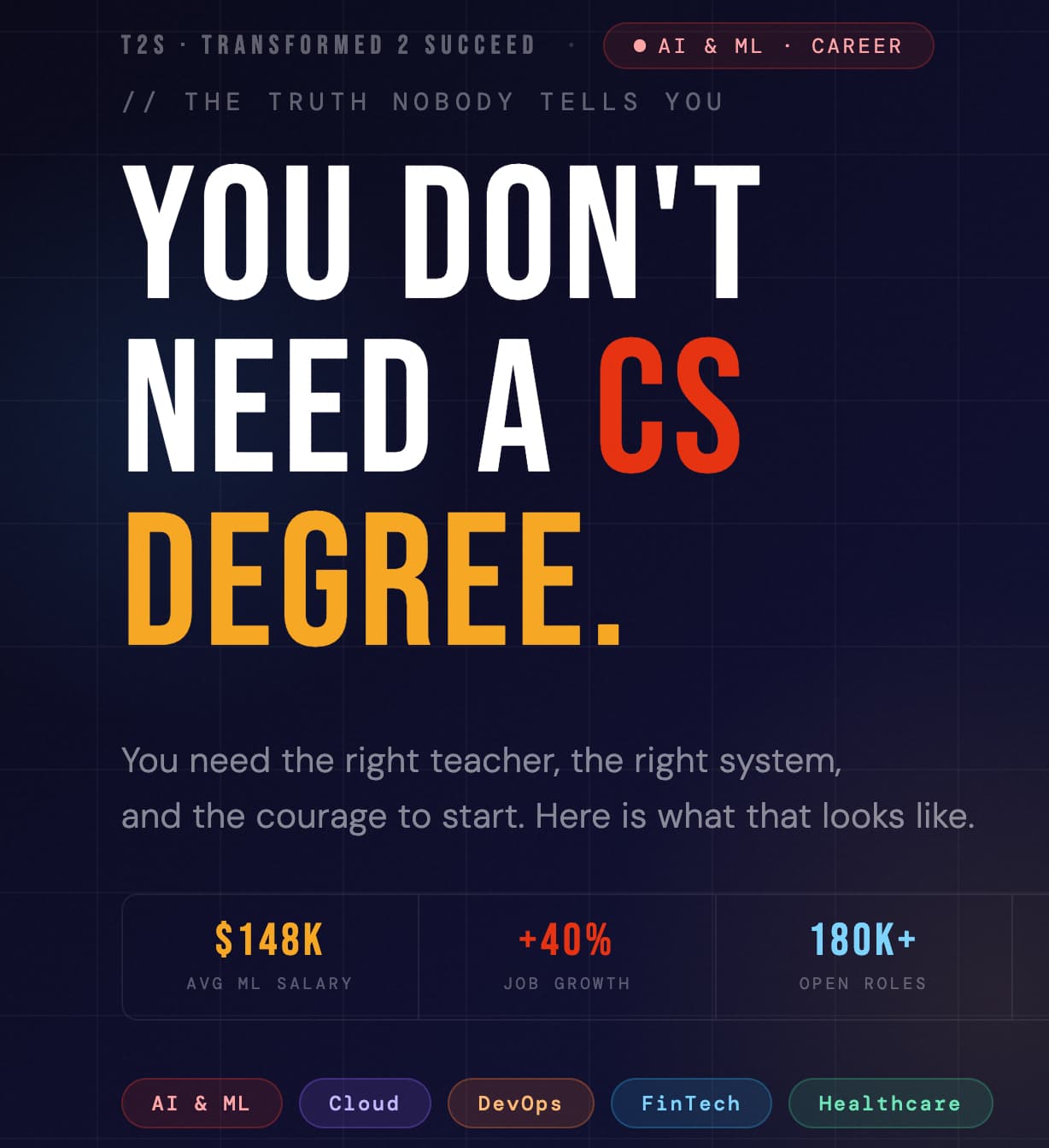
The average machine learning engineer in the United States earns $148,000 per year. AI and ML job growth is projected at over 40% between now and 2030. There are more than 180,000 open AI and ML roles in the United States right now, and the number is not going down.
Healthcare and financial services are two of the fastest-growing sectors for AI. Fraud detection. Patient risk prediction. Clinical language processing. Credit scoring. These are not science fiction. These are production systems running in hospitals and banks right now, and the people who know how to build and maintain them are in high demand.
The gap between the demand for these skills and the number of people who have them is enormous. And most of the people who could close that gap are sitting on the sidelines because no one has shown them a real path forward.
That is what I built this program to do.
What This Program Actually Is
Zero to AI Systems Engineer is a 6-month live cohort program that takes you from wherever you are right now to someone who can build, deploy, and maintain real AI systems in the cloud, on any cloud platform.
Not theoretical. Not self-paced videos you watch and forget. Live instruction. Real labs. Real systems.
Every Tuesday and Thursday evening, we meet live on Zoom for two hours. I teach the concept. Then we build it together. By the time you leave a session, you have not just heard about something; you have done it.
The first four months are hands-on technical training:
You start with the foundations, Python, data pipelines, and how machine learning actually works. No prior coding experience required. Month one is designed to take you from zero to dangerous.
In month two, you are training fraud-detection models and patient-risk prediction systems. Real datasets. Real problems.
Month three, you go into generative AI and large language models; how they work, how to build with them, how to deploy them into applications that real people use.
Month four, you deploy everything into the cloud, cloud-agnostic, which means you learn skills that work on AWS, Azure, GCP, or any other platform. You learn MLOps, CI/CD pipelines, and how to keep AI systems running and improving in production.
Then the last two months shift to something most programs skip entirely: getting you hired.
You build your Capstone project, a complete, real, deployable AI system in the industry track you choose: Cloud Engineering, DevOps/MLOps, Fintech, or Healthcare. You build your portfolio.
We transform your resume. We do mock interviews until you are genuinely confident. We work on salary negotiation.
I meet with you one-on-one. And you leave with a job-search strategy tailored to you.
Who I Am, and Why That Matters
I hold a Doctor of Ministry and a PhD, combining Biblical studies, Neuroscience, and Counseling research. I am completing a third doctorate in Computer Science, with research focused on AI and machine learning in regulated environments, specifically healthcare and financial systems.
I have worked inside enterprise organizations. I have operated at the intersection of large-scale IT infrastructure and cloud-native systems. I have seen what hiring managers are actually looking for, what production systems actually need, and where most training programs fall short.
I am not teaching from a textbook. I am teaching from years of doing the real work.
But here is the part that matters most to me: I also spent years in pastoral ministry. I hold a doctorate in how people think, grow, and change. That means I understand that this kind of transformation, the kind that changes your career and your financial future, is not just a technical challenge. It is a human one.
I built this program because I watched too many talented people get stuck, not because they were incapable, but because no one gave them a real path forward they could actually afford.
Why This Program Is Priced the Way It Is
Comparable AI bootcamps charge $15,000 to $25,000, which is less than what this program includes. University certificate programs from MIT, Stanford, and Cornell run $8,000 to $18,000. Most of them are pre-recorded and lack live instruction, mentorship, or career coaching.
This program isn't priced that way. And the reason is simple: I am not building a revenue stream. I am building a generation of people who can contribute to industries that matter.
Transformation should not be a privilege. That is not marketing language. That is my actual conviction, shaped by years of ministry, doctoral research in human psychology, and watching talented people stay stuck because they could not afford the door.
This is the founding cohort. The first group. And founding cohort pricing reflects that mission directly. As the program grows, as alumni results accumulate, and as demand increases, the price will rise to reflect the value it delivers.
What you pay to join this cohort locks in permanently for you.
The Founding Cohort Advantage
Every program that exists today was once a first cohort. Someone was first at Harvard, first at MIT, first at every bootcamp you have ever heard of. Being first here means something real.
You get more of my direct attention than any future cohort will. The class is capped at 50 students, not because of a software limitation, but because 50 is the number where I can still know your name, your goals, and your progress.
During the mentorship phase, I meet with students individually. That level of access is only possible at this size.
You also get the ability to shape what this program becomes. Founding cohort students are not just recipients of a program, they are participants in building it. Your feedback matters. Your experience matters. And founding alumni recognition is a real differentiator that later cohorts will only be able to read about.
The people who move first tend to move furthest. I have seen that play out across my years of mentorship. The ones who act when the window is open are the ones who look back and say it changed everything.
What Students Build
You will not be building toy demos. You will be building the kind of systems that belong on a resume, systems an interviewer can actually run, test, and be impressed by.
A fraud detection API that processes real transaction data. A patient risk prediction model that flags hospital readmission risk. A RAG pipeline that answers questions grounded in real documents.
A production LLM wrapper with cost controls, retry logic, and observability. A Kubernetes deployment that self-heals and scales.
These are not exercises. These are AI systems. And you will have built them from scratch, deployed them to the cloud, and monitored them in production, before you ever walk into an interview.
Who This Is For
- If you have ever worked in IT, even in a non-technical role, you qualify.
- If you are a cloud or DevOps engineer wondering how to grow into AI, this was built for you.
- If you are a career changer who wants to enter technology through a door that leads somewhere meaningful, this is that door.
- If you are a student or recent graduate who wants to build real skills before your first interview, this gives you the portfolio to do it.
You do not need a computer science degree. You need the right teacher, the right system, and the courage to start.
How to Take the Next Step
If what you just read resonates with you, if any part of it describes where you are or where you want to go, I want to hear from you.
You can visit the program page at www.emmanuelnaweji.com/ai-course to see the full program breakdown, curriculum, and everything included.
If you have questions before you decide, or if you want to understand whether this is the right fit for your background, goals, or schedule, please reach out to me directly. Use the contact form on the registration page, and your message comes straight to me. I actually read them. I actually respond.
The cohort starts June 2, 2026. Classes meet Tuesday and Thursday, 7:30 to 9:30 PM EST. 50 students maximum. One start date.
If this is for you, now is the time.